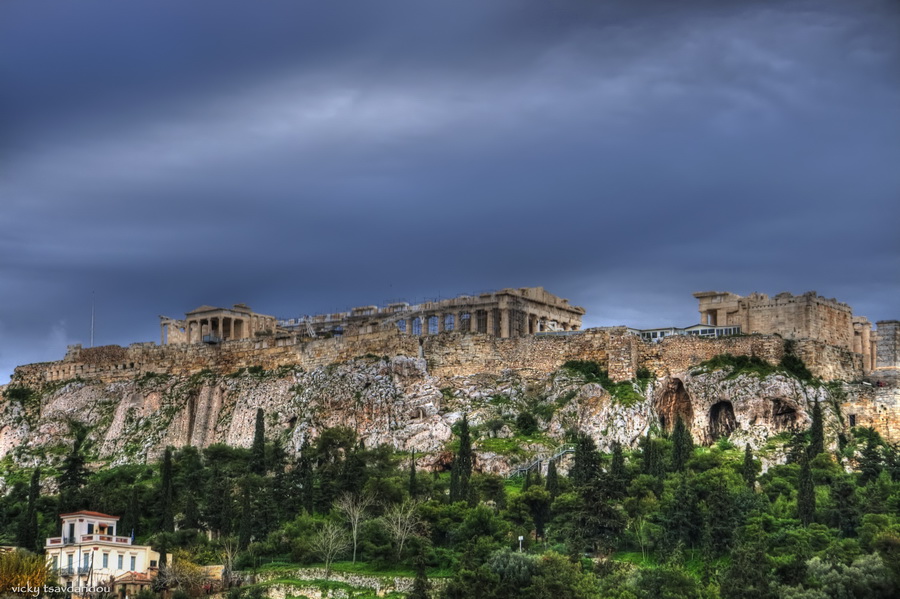
The Parthenon (Ancient Greek: Παρθενών) is a temple of the Greek goddess Athena whom the people of Athens considered their protector. Its construction began in 447BC and completed in 432BC on the Athenian Acropolis, although decorations of the Parthenon continued until 431BC. It is the most important surviving building of Classical Greece, generally considered to be the culmination of the development of the Doric order. Its decorative sculptures are considered one of the high points of Greek art. The Parthenon is regarded as an enduring symbol of ancient Greece and of Athenian democracy, and one of the world's greatest cultural monuments. The Greek Ministry of Culture is currently carrying out a program of selective restoration and reconstruction to ensure the stability of the partially ruined structure.
The Parthenon itself replaced an older temple of Athena, which historians call the Pre-Parthenon or Older Parthenon, that was destroyed in the Persian invasion of 480 BC. Like most Greek temples, the Parthenon was used as a treasury. For a time it served as the treasury of the Delian League, which later became the Athenian Empire. In the 6th century AD, the Parthenon was converted into a Christian church dedicated to the Virgin Mary. After the Ottoman Turk conquest, it was turned into a mosque in the early 1460s, and it had a minaret built in it. On 26 September 1687 an Ottoman Turk ammunition dump inside the building was ignited by Venetian bombardment. The resulting explosion severely damaged the Parthenon and its sculptures. In 1806, Thomas Bruce, 7th Earl of Elgin removed some of the surviving sculptures, with Ottoman Turk permission. These sculptures, now known as the Elgin Marbles or the Parthenon Marbles, were sold in 1816 to the British Museum in London, where they are now displayed. The Greek government is committed to the return of the sculptures to Greece, so far with no success.

 Αναρτήσεις


